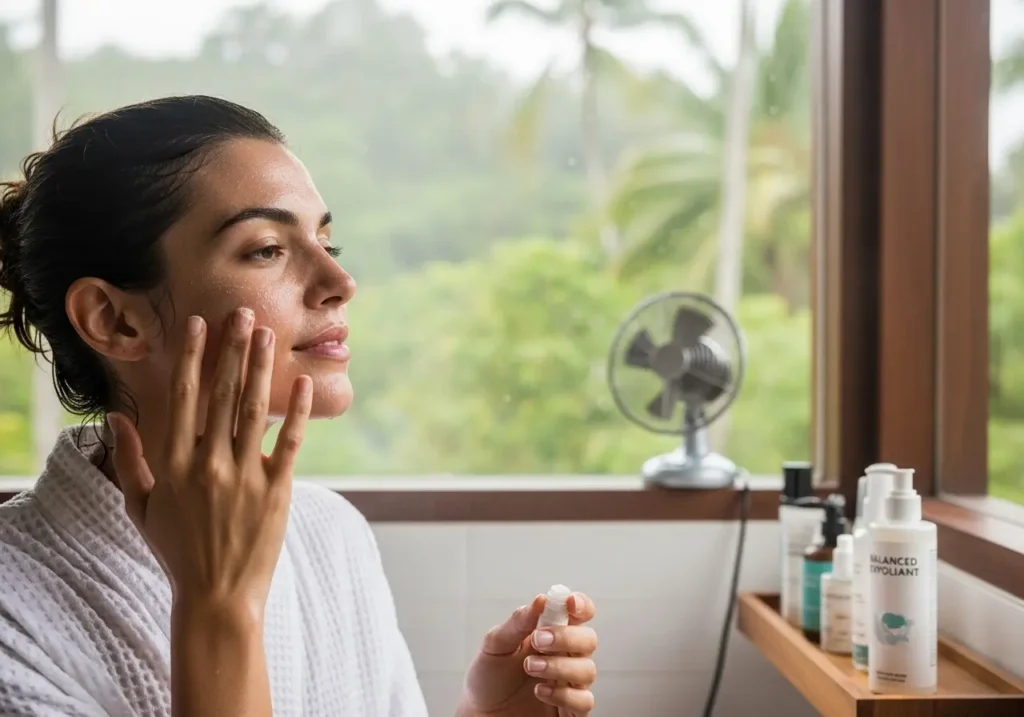
Good Airplane Skin Prep starts long before you buckle your seatbelt. If your face usually feels tight, dull, puffy, greasy, or weirdly flaky after flying, the problem is rarely just “dry cabin air.” It is usually a stack of smaller mistakes: over-exfoliating the night before, wearing the wrong makeup, skipping barrier support, forgetting sunscreen on daytime flights, or treating travel skin like it should behave exactly the way it does at home.
I have learned this the hard way on short hops, red-eyes, and long-haul flights that turn your face into a confusing mix of dehydration and shine. The people who land looking decent are not always using expensive products. They are usually doing fewer things, but doing them at the right time. That is the real travel skincare advantage. A smart pre-flight routine, a restrained in-flight strategy, and one solid recovery plan after landing will beat a stuffed toiletry bag almost every time.
Why flying messes with your skin so quickly
Air travel changes the environment around your skin in ways that show up fast. Your face loses comfort first, then balance. Dryness increases, oil can become less predictable, makeup starts sitting badly, and any weak point in your routine becomes obvious.
The biggest culprits are easy to recognize once you know the pattern:
Dry cabin conditions pull moisture from the skin faster.
Long hours sitting in recycled air can make skin feel stale and stressed.
Sleep disruption shows up as puffiness, dullness, and uneven texture.
Travel stress can trigger breakouts or redness.
Salty airport food and low water intake often make swelling worse.
Touching your face more often during travel does not help.
That is why flight skincare should be less about chasing glow and more about protecting balance. If your barrier stays comfortable, everything else gets easier.
The hidden reason travel skin looks “off”
Most people assume airplane skin is just dry skin. It is usually more complicated than that. Travel skin is often dehydrated but not necessarily dry.
That distinction matters:
Dry skin lacks oil.
Dehydrated skin lacks water.
You can absolutely be oily and dehydrated at the same time.
This is why some travelers land with a tight forehead and greasy nose and have no idea what happened. Their skin is compensating. When it loses water, it often becomes shinier, more reactive, and less even-looking. That is why stripping products and aggressive cleansing usually make the situation worse.
Airplane Skin Prep starts the night before
Most in-flight skin problems begin with what happened 12 to 24 hours earlier. If you overdo active ingredients before travel, your skin arrives at the airport already stressed.
What to do the night before a flight
The best pre-flight evening routine is calm and practical. You want skin that is stable, lightly hydrated, and not irritated.
A strong night-before routine usually looks like this:
Gentle cleanser.
Hydrating serum or essence if your skin likes one.
Barrier-supportive moisturizer.
Optional eye cream if dryness around the eyes is common for you.
Lip balm before bed.
What usually works well:
Ceramides.
Glycerin.
Hyaluronic acid in a balanced formula.
Panthenol.
Squalane.
Niacinamide if your skin already tolerates it.
What to avoid the night before
This is where many people sabotage themselves.
Skip or reduce:
Strong exfoliating acids.
Retinoids if your skin is even slightly reactive.
Peels.
Clay masks.
New products.
Anything that makes your face feel “tight but smooth.”
That last effect is deceptive. Smoothness right after an active-heavy routine can turn into irritation halfway through a flight.
The unusual pre-flight tip that actually helps
If I had to give one unconventional rule, it would be this: prepare for the plane by making your skin slightly more boring than usual.
That means:
fewer actives,
more barrier support,
less experimentation,
and no trying to create a dramatic glow the night before.
Air travel punishes fragile, over-polished skin. It rewards steady skin.
What to do the morning of your flight
Morning flight skincare depends on flight length, time of day, and whether you plan to wear makeup. But the basic principle stays the same: create a comfortable base that will not collapse mid-flight.
Best morning skincare before flying
For most people, this works well:
Gentle cleanse or just rinse, depending on skin type.
Lightweight hydrating layer.
Moisturizer suited to your skin type.
Sunscreen, especially for daytime travel.
Minimal makeup or no makeup, depending on flight length.
The goal is not a full beauty routine. It is a stable travel face.
Daytime flights need sunscreen
This gets overlooked constantly. If you are flying during daylight, sunscreen matters. Window exposure and bright travel days are not the time to skip it, especially if you are sitting near the window or traveling after using active skincare in the days before.
Choose a sunscreen that:
feels comfortable under moisturizer,
does not pill,
and does not become greasy after hours of wear.
If your sunscreen already annoys you on a normal day, it will annoy you more on a plane.
Best moisturizer choice before boarding
This depends on your skin type.
The mistake is assuming oily skin should skip moisturizer. On a plane, that often backfires.
Should you wear makeup on a flight?
This depends on the flight, your skin, and your comfort level. There is no universal rule, but there is a smart one: the longer the flight, the more likely heavy makeup becomes a bad idea.
Best makeup approach for short flights
For short flights, a light makeup look can be totally fine:
tinted moisturizer or skin tint,
concealer where needed,
cream blush,
brows,
mascara,
lip balm or soft lip color.
If the flight is two hours and you are heading straight to a meeting or event, this is realistic.
Best makeup approach for long-haul flights
For long flights, I strongly prefer minimal base makeup or none at all.
Why:
Full foundation can separate as skin dehydrates.
Powder can start looking flat and dry.
Reapplying skincare over makeup gets messy fast.
Your skin usually feels better with less on it.
A better long-haul formula:
skincare only,
maybe concealer,
brows,
curled lashes or mascara if you care,
lip balm.
That usually lands better than trying to preserve a full face through 8 to 12 hours of cabin air.
If you must wear more makeup
Keep it flexible:
thin layers,
creamy formulas,
less powder,
and no overly matte base products.
Travel air tends to punish matte, heavy, and over-set makeup first.
What to bring in your carry-on for airplane skin prep
The best in-flight skincare kit is compact. It solves discomfort without turning your tray table into a vanity counter.
Smart carry-on skincare essentials
Bring:
Lip balm.
Hand cream.
Small moisturizer or barrier cream.
Sunscreen stick or travel sunscreen for daytime arrival or long daylight flights.
Gentle face mist only if you know how to use it properly.
Optional hydrating serum stick or balm for dry spots.
Tissues or clean cotton pads if needed.
That is enough for most flights.
What you probably do not need
Skip:
multiple masks,
five-step touch-up routines,
exfoliating pads,
strong actives,
or anything that requires a full cleanse in the middle of the flight.
A plane is not a treatment room. Your goal is maintenance, not transformation.
Face mists: helpful or overrated?
This is one of the most misunderstood parts of travel skincare. A face mist can feel amazing in the moment, but it is not always doing what people think.
When a face mist helps
A mist helps if you use it as part of a hydration sandwich:
light mist,
then moisturizer or balm on top.
That traps the extra moisture and gives the skin something useful to hold.
When a face mist makes things worse
If you spray a mist repeatedly and leave the skin bare afterward, it can actually make your face feel tighter later, especially in very dry air. The water evaporates. Comfort disappears. Then you spray again and repeat the cycle.
So yes, bring a mist if you love it. Just do not confuse refreshing with treating.
My honest take on mists
I see mist as optional. A small moisturizer, lip balm, and sunscreen are more important. A mist is the nice extra, not the core plan.
In-flight skincare: what to do during the flight
This is where restraint pays off. Most people do not need a complicated routine midair. They need a few well-timed comfort moves.
For short flights
For short flights, you may not need to do much at all.
Good plan:
lip balm once or twice,
hand cream,
maybe moisturizer if skin feels tight,
sunscreen if landing into bright daytime conditions.
That is enough.
For long flights
On longer flights, especially overnight or long-haul routes, I recommend a simple refresh strategy:
Reapply lip balm as needed.
Use a small amount of moisturizer on dry areas.
Avoid picking at skin or touching your face frequently.
If your skin feels extremely tight, press in a little cream rather than rubbing aggressively.
Reapply sunscreen before landing if it will still be daylight.
Should you cleanse mid-flight?
Usually, no. Not fully. Unless you have a very specific reason, a complete in-seat cleansing routine is more fuss than value.
If you need a refresh:
use a soft tissue,
blot excess oil gently,
maybe remove makeup after a red-eye if you truly cannot stand it,
then apply a simple moisturizer.
That is usually enough.
Lip care and hand care matter more than people expect
People obsess over serums and forget the parts that become visibly uncomfortable fastest.
Why lips get wrecked on planes
Lips dry out quickly during flights, especially if you:
drink less water,
breathe through your mouth,
wear long-lasting matte lip products,
or forget balm until the damage is already there.
Use a balm before boarding and reapply before your lips feel desperate, not after.
Hands tell the truth too
Hand sanitizer, dry air, and frequent washing can make hands look rough quickly. A good hand cream improves comfort fast and keeps the rest of you from feeling travel-worn.
These details matter because “looking fresh” often has less to do with complexion perfection and more to do with whether the small high-friction areas still look normal.
Related Post: Strength Training for Women Over 40
What not to do on a plane if you care about your skin
This section saves more regret than any shopping list.
Skip sheet masks in your seat
Could you use one? Sure. Should you, most of the time? No.
Why not:
awkward in shared space,
inconsistent payoff,
often followed by sticky residue,
and not always practical or hygienic.
If you love them, use one after landing in private. Your seat is not the best setting.
Avoid strong actives mid-flight
No retinoids. No acids. No exfoliating wipes. No “instant peel” pads. This should be obvious, but people still do too much because boredom and travel anxiety make skincare feel productive.
Do not keep layering random products
If your face starts feeling weird, the answer is not always more product. Sometimes it is just one small layer of moisturizer and then leaving your skin alone.
The biggest airplane skincare mistake
The biggest mistake I see is trying to create glow on the plane instead of preserving comfort.
Glow is the wrong goal at altitude. Calm is the goal. If your skin feels balanced, it will look better on landing anyway.
Airplane Skin Prep for different skin types
A good travel skincare plan changes depending on how your skin behaves normally.
Airplane Skin Prep for dry skin
Dry skin usually struggles most with tightness and flaking during flights.
Focus on:
richer moisturizer before boarding,
lip balm,
minimal makeup,
small reapplications of cream during long flights,
and avoiding strong actives before travel.
A balm or ointment on very dry spots can help, especially around the nose or mouth.
Airplane Skin Prep for oily skin
Oily skin still needs hydration. The trick is using lighter textures.
Best approach:
lightweight hydrating serum,
gel-cream moisturizer,
comfortable sunscreen,
less heavy base makeup,
blotting instead of constant cleansing.
Do not respond to in-flight shine with harsh wiping or oil-stripping. That usually makes the skin look worse later.
Airplane Skin Prep for sensitive skin
Sensitive skin needs the simplest plan.
Use:
familiar products only,
fragrance-free options,
stronger barrier support,
no exfoliation before flight day,
and as little experimentation as possible.
Travel days are not the time to test your skin’s character.
Airplane Skin Prep for acne-prone skin
Acne-prone skin does best when it stays clean, calm, and not overloaded.
Best strategy:
avoid occlusive layers that are too heavy for your skin,
keep hands off your face,
do not pile on multiple in-flight products,
use a non-comedogenic moisturizer,
and avoid trying to “treat” breakouts aggressively during travel.
Over-treating pimples before or during a flight often leaves you with irritation plus a breakout, which is the worst combination.
What to do after landing
Landing skincare matters because it helps your face recover from the dry, stale travel environment and adapt to the new climate.
Best post-flight routine
Once you can wash properly, do this:
Gentle cleanse.
Hydrating serum or essence.
Moisturizer.
Sunscreen if it is daytime.
Optional concealer or light makeup if needed.
That is enough to make your skin feel normal again.
After a red-eye flight
A red-eye usually leaves the face duller, puffier, and more uneven.
What helps:
cool water rinse or gentle cleanse,
caffeine eye product if you like one,
hydrating layers,
sunscreen,
and minimal complexion makeup instead of heavy foundation.
The goal is to reduce evidence of fatigue, not hide it under three extra products.
When to use actives again
If your skin feels normal after landing, you can usually return to your usual routine that evening. If it feels tight, red, flaky, or fragile, give it one more recovery day before bringing back stronger actives.
This is where patience pays off. One extra calming night is often smarter than jumping right back into exfoliation.
Airplane skin prep for long-haul travel and time-zone shifts
Long-haul flights create a different kind of skin stress because they combine dehydration, sleep disruption, cabin air, and time-zone confusion.
Best long-haul strategy
Think in three phases:
Before boarding
Gentle cleanse.
Hydration.
Moisturizer.
Sunscreen for daytime flights.
Minimal makeup.
Mid-flight
Lip balm.
Moisturizer as needed.
Water.
Minimal touching.
Sunscreen before landing if needed.
After landing
Cleanse properly.
Rehydrate the skin.
Moisturize.
Keep actives low until your face feels settled.
That is the entire framework. It is simple because simplicity survives travel.
Time-zone confusion shows up on the face
Sleep loss often causes:
puffiness,
under-eye darkness,
dehydration,
dullness,
and breakouts a day later.
This is why travel skincare should not just focus on the plane itself. The 24 hours after arrival matter just as much.
Food, water, and travel habits that affect your skin more than products do
No skincare article should pretend products do all the work. Travel habits show up on your face quickly.
Water matters, but not in a magical way
Yes, hydrate. No, drinking one bottle of water will not erase all in-flight dryness. Think of water as supportive, not miraculous.
A better approach:
drink consistently through the travel day,
not just once you already feel awful,
and avoid swinging between dehydration and emergency hydration.
Salt, alcohol, and sugar show up fast
Airport food, travel treats, and inflight drinks can make puffiness and dullness worse quickly if the whole day becomes a salt-and-sugar festival.
You do not need perfect travel nutrition. You do need a little restraint if your skin reacts easily.
Sleep posture and face touching
Small habits matter:
pressing your face into a dirty hoodie sleeve for six hours is not ideal,
neither is rubbing your eyes repeatedly,
nor picking at one small bump because you are bored.
The cleanest travel skin hack is often behavioral, not topical.
The best Airplane Skin Prep routine by travel scenario
For a two-hour daytime flight
Moisturizer.
Sunscreen.
Light makeup if wanted.
Lip balm.
Done.
For a five-hour flight with dry skin
Hydrating serum.
Richer moisturizer.
Sunscreen.
Minimal makeup.
Lip balm and small cream in carry-on.
For a long-haul overnight flight
Barrier-focused skincare.
Little to no foundation.
Lip balm.
Small moisturizer.
Gentle refresh after landing.
For acne-prone skin traveling to a hot climate
Light hydration.
Non-heavy moisturizer.
Sunscreen.
Keep hands off face.
Do not over-layer products in flight.
For sensitive skin after recent active use
Pause exfoliants the night before.
Use only familiar products.
Keep the routine short.
Moisturize well.
Recovery first, actives later.
My definitive advice on Airplane Skin Prep
The best Airplane Skin Prep is not a ten-step luxury ritual. It is a calm, well-timed routine that protects your barrier before the flight, avoids unnecessary stress during the flight, and helps your skin recover after landing. If you want the safest smart formula, do this: skip strong actives the night before, moisturize well, wear sunscreen on daytime flights, keep makeup lighter than usual, bring only lip balm plus one good moisturizer, and stop trying to turn the plane into a spa.
If your skin usually falls apart while traveling, simplify harder. That is the real fix. One gentle cleanser, one hydrating layer, one good moisturizer, sunscreen, and fewer impulsive mid-flight products will usually do more for your face than a carry-on full of trendy skincare. The goal is not to land glowing like a campaign shoot. It is to land looking like your skin survived the trip with its balance intact.