The Wind Tunnel Effect is one of those building problems people notice instantly and explain badly. A balcony door jerks open. A corridor corner feels like it has its own weather system. Outdoor chairs creep, cushions disappear, and a pleasant terrace becomes a place you only use in screenshots. I’ve seen this happen in towers, mid-rise corners, podium decks, and exposed urban balconies, and the pattern is usually the same: the building shape, gaps between structures, and surrounding layout are doing more of the damage than the furniture itself.
That matters because the best fix is rarely “buy heavier stuff and hope.” Wind around buildings speeds up when air is squeezed through narrower gaps, and tall façades can push airflow downward to ground or podium level, where corners often feel worst. Once you understand that, the solutions get smarter. You stop treating every gust like bad luck and start treating the apartment, balcony, or shared outdoor zone like a microclimate problem with specific weak points.
Why the Wind Tunnel Effect feels so much worse around tall buildings
Air near the ground is normally slowed by friction from trees, surfaces, and buildings, but wind speed rises again when flow gets constricted by narrow passages, open corners, valley-like gaps, or abrupt building geometry. That is why one part of a property can feel calm while another feels borderline hostile, even on the same day.
In practice, wind tunnel conditions show up in a few predictable places:
between towers or blocks,
at street corners,
around podium edges,
near tall blank façades,
at balcony edges,
and beside entry doors that face a direct wind path.engineering.
The four mechanisms that cause most of the trouble
A lot of wind discomfort in high-rises comes from the same four behaviors:
Venturi acceleration: air speeds up when it is forced through a tight gap or corridor-like opening.
Downwash: taller façades can push faster air downward, where it accelerates again around corners at lower levels.
Channeling: long straight passages, streets, or open building alignments can guide wind directly through a site.
Corner acceleration: sharp building edges and exposed corners can intensify gusts right where people try to walk, sit, or open doors.
That is the technical side. The lived version is simpler: one badly exposed edge can ruin an otherwise beautiful space.
Why some balconies feel impossible to use
A balcony becomes miserable when three things happen together:
wind has a clean path toward it,
the railing or edge gives no useful deflection,
and the furniture layout leaves nothing to break the airflow.
This is why some people keep replacing outdoor pieces and still hate the balcony. The setup is responding to wind instead of managing it.
Wind Tunnel Effect solutions that work without changing the whole building
Most residents cannot redesign the tower. That does not mean you are powerless. You just have to work at the scale you control: balcony layout, surface porosity, barrier placement, storage habits, and how you create shelter zones rather than one wide-open exposed zone.
Start by mapping the gust path
Before you buy screens, planters, or heavier furniture, spend two or three windy days watching the space.
Check:
Where does the strongest gust first hit?
Does wind curl around one corner?
Does it rise from below the railing or hit from above?
Is the worst moment tied to opening the balcony door?
Which seat or edge becomes unusable first?
This sounds almost too basic, but it is the most useful step. Wind fixes fail when people treat the whole balcony as equally exposed. It usually is not.
Protect the most-used zone, not the entire edge
This is my strongest practical recommendation. Do not try to defend every inch of outdoor space equally. Build one usable calm pocket first.
That usually means:
shielding one chair zone,
one small dining corner,
one plant cluster,
or one side of the balcony that gets daily use.
A calm 30 percent of the space beats a windy 100 percent every time.
Use partial barriers, not giant solid walls
This is where most DIY fixes go wrong. A fully solid barrier can block wind immediately behind it, but it can also create turbulence and messy air movement downwind. More porous screens tend to diffuse airflow better than solid ones, especially when the goal is comfort rather than total blockage.
For many balconies, better options are:
slatted privacy screens,
mesh windbreak fabric,
perforated panels,
open planters with dense foliage,
or screens that block part of the flow instead of all of it.
A slightly porous screen often hosts better than a hard wall. Less drama. More usable calm.
Balcony and terrace fixes that make outdoor areas livable again
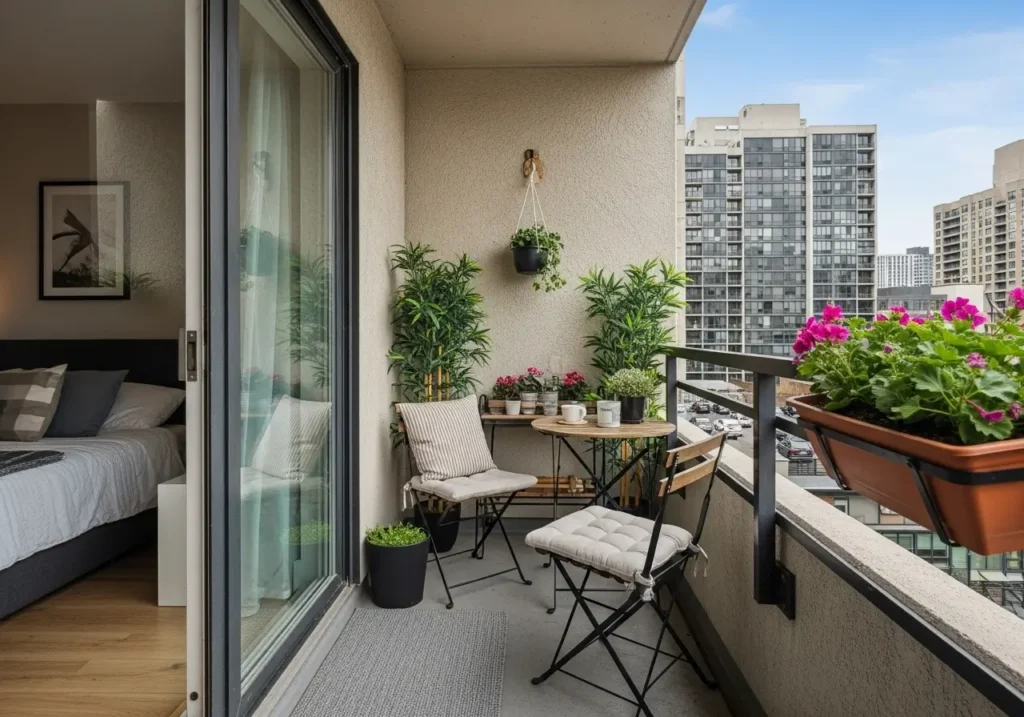
If your main complaint is that the balcony feels like a launch pad for cushions and lightweight decor, the strategy should focus on anchoring, deflecting, and reducing clean wind paths.
Best balcony layout for windy high-rises
The worst layout is usually the one most people choose first: furniture pushed right to the exposed edge, open floor in the middle, and nothing to slow wind before it reaches the seating.
A stronger layout looks like this:
heavier items closest to the windward side,
seating tucked behind a partial shield,
planters used as side protection rather than scattered decor,
and the lightest accessories kept farthest from direct gust channels.
Think of the balcony in layers:
Impact layer: where wind first arrives.
Buffer layer: where you place screens, planters, or heavier pieces.
Comfort layer: where people actually sit.
That sequence changes everything.
Planters are better wind tools than most people use them for
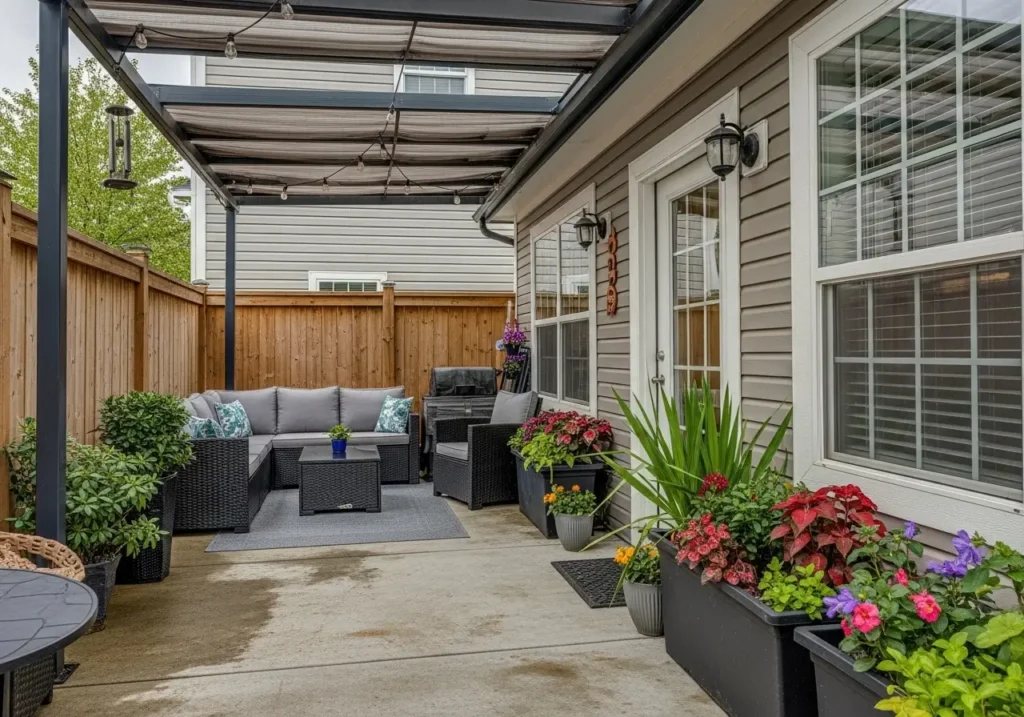
Dense planters do more than decorate. Used well, they help break flow, soften gusts, and create side protection. Planting and screens are widely recommended as wind-mitigation tools because they reduce speed, redirect airflow, and improve microclimate around occupied areas.
The best planter strategy is not lining the whole railing with tiny pots. It is:
one tall cluster near the worst corner,
one side barrier beside seating,
and one anchor planter where wind turns or funnels.
Good choices for windy setups:
tall grasses,
dense shrubs,
layered mixed planters,
and containers heavy enough not to shift.
Why fences and screens should not be completely solid
For outdoor comfort, slightly porous barriers are often more effective than fully solid ones because they reduce wind speed while creating less turbulence behind the barrier. The BRANZ guidance is especially useful here: fences around 40 to 50 percent open can create a sheltered lee zone extending roughly four to five times the fence height.
That does not mean every balcony needs a custom engineering project. It means a slatted or breathable screen often works better than a big acrylic wall that just sends gusts somewhere else.
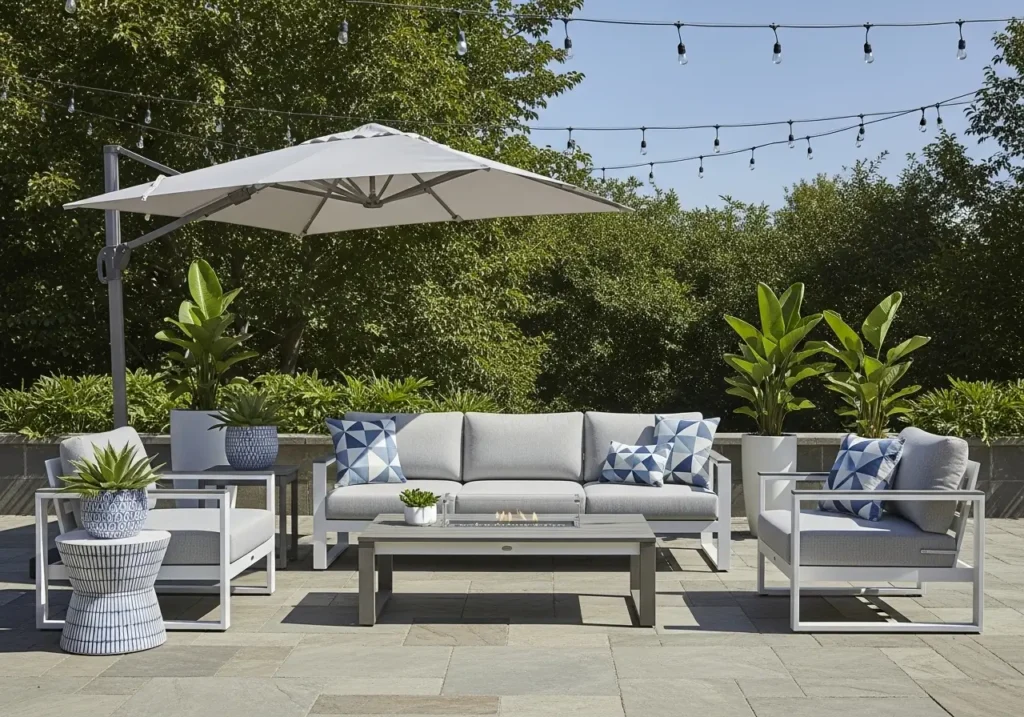
Choose heavier, lower, calmer furniture
Windy balconies punish tall, lightweight, top-heavy outdoor furniture.
What usually works better:
low-profile loungers,
wider-base chairs,
heavier tables,
benches with real weight,
storage boxes that double as anchors,
and pieces with fewer flat sail-like surfaces.
What usually fails:
tall bar sets,
featherweight foldable chairs,
oversized umbrellas in exposed zones,
and cushions with nothing securing them.
If your outdoor setup includes seating or textiles, this is also worth keeping handy: Patio Furniture Covers Outdoor Protection. In high-wind buildings, protection is not just about rain. It is about reducing wear, grit buildup, and the slow damage that constant gusts do to fabrics and frames.
Door, entry, and corridor fixes for indoor comfort
Some of the most annoying wind tunnel problems happen indoors or half-indoors: doors slamming, cold air rushing through corridors, or apartment entries that feel like mini pressure events.
Why doors slam in windy buildings
When air speeds up through a constricted area or pressure differences build across an entry path, doors can swing or slam much harder than expected. In towers and exposed buildings, this often shows up at:watersonusa
lobby doors,
balcony doors,
stairwell transitions,
and apartment doors near open corridors or strong exterior exposure.
How to reduce door-related wind problems
Start with the basics:
check seals and gaskets,
slow the door closer if the hardware allows,
add sweep or threshold sealing where drafts are obvious,
and reduce direct crossflow by not leaving opposing doors or windows open at the same time.
Then improve the zone itself:
use a console, bench, or screen to soften the wind path inside the apartment,
avoid leaving the entry directly open to a long hallway view,
and keep loose items away from the pressure line.
In other words, do not let the apartment form its own little wind corridor.
Create an airlock feeling when possible
You probably cannot build a real vestibule, but you can create a softer transition.
Useful moves:
place a narrow screen or tall shelving unit offset from the entry line,
use heavier curtains in glass-door areas,
add a runner and soft furnishings to reduce the harshness of moving air,
and avoid layouts where the balcony door and main entry visually connect in one straight path.
Long, wide, straight openings are exactly the kind of geometry wind likes.
Design-level mitigation ideas for owners, developers, and building managers
If you have more control than a typical renter or tenant, the fix can move from furniture-level to site-level. That is where wind problems become more expensive to ignore and much more satisfying to solve properly.
Building form matters more than decorative fixes
Site layout and building shape are major drivers of wind impact, and the BRANZ guidance is blunt about it: wind can be reduced through siting, layout, building form, planting, fences, screens, and even reshaping land forms. It also recommends avoiding small gaps that act as wind funnels, reducing long straight streets or passages, and keeping building heights relatively uniform so abrupt changes do not create strong local downdrafts.
For larger projects, that usually means looking at:
tower spacing,
podium design,
façade modulation,
corner treatment,
canopies,
and where public seating is placed relative to corners and windward faces.
Podiums, canopies, and step-backs are not cosmetic
Stepped façades, verandas, and canopies are recommended because they help reduce downdrafts and provide shelter at ground level. Rounded or chamfered corners can also reduce downwashing and corner acceleration by softening pressure differences around the building edge.
That is the difference between a tower that looks sleek in renderings and one that feels usable at street level. Great architecture is not just what the building looks like from far away. It is whether a person can stand near it without getting shoved sideways by December wind.
Landscaping works best when it deflects, not dams
This is a subtle point and one of the best insights in the BRANZ bulletin: shelter planting performs better when it deflects wind and allows some flow through, rather than acting like a hard dam that creates turbulence or gusting between gaps. Shelter belts around 50 to 60 percent porous can provide good protection while reducing lee-side turbulence.
Translated into practical design:
mixed planting beats a few isolated specimens,
dense low planting matters as much as upper foliage,
and big gaps in a hedge or screen can turn into acceleration points.
The smartest way to diagnose and fix a Wind Tunnel Effect problem
Most people attack wind like it is random. It is not. It is patterned, directional, and usually tied to geometry.
Here is the process I recommend:
Step 1: Identify the real exposure type
Is the problem mainly:
a corner gust,
a balcony edge,
a tower-to-tower channel,
a downwash zone,
or a door pressure problem?
Step 2: Decide what you actually need
Do you need:
a usable chair zone,
less furniture movement,
fewer slamming doors,
a calmer entry,
or a safer shared outdoor area?
Step 3: Choose the right scale of fix
Resident scale: screens, planters, layout, heavier furniture, covers.
Owner scale: railing upgrades, fixed screens, wind-tolerant planting, door hardware.
Building scale: canopies, corner redesign, façade modulation, podium treatment, landscape barriers.
Step 4: Test one buffer first
Do not redesign the whole space at once. Add one side screen, one planter cluster, or one heavier furniture anchor and see what changes.
Step 5: Keep the goal realistic
You are usually not trying to create total stillness. You are trying to reduce acceleration, soften gusts, and make the space predictable enough to use.
That last part matters. People enjoy outdoor areas that feel calm enough, not perfect.
Common mistakes that make wind problems worse
I see the same five errors again and again.
1. Treating every gust as a furniture problem
If chairs keep moving, the wind pattern is the issue. Heavier furniture helps, but layout and buffering matter more.
2. Using fully solid screens too early
A solid panel can create new turbulence if it is placed badly or blocks too much flow.
3. Decorating the exposed edge instead of protecting it
The edge that takes the hit should be defensive, not delicate.
4. Leaving long straight paths open
Wind loves alignment. If the site, corridor, or balcony layout gives it a direct path, it will take it.
5. Ignoring corners
Corners are often the worst spots because downwash and corner acceleration intensify there.engineering.
What I would do first in a real high-rise unit
If I walked into a windy apartment tomorrow, I would do this in order:
Watch the space during two windy periods.
Mark the first-hit edge and worst corner.
Move seating away from that line.
Add one porous side screen or dense planter cluster.
Replace the lightest, tallest outdoor piece first.
Secure textiles and stop storing loose accessories outside.
Adjust the door zone so the apartment itself does not become a draft corridor.
That sequence works because it starts with pattern, not panic.
The best Wind Tunnel Effect solution is not usually a dramatic one. It is a layered one: understand where wind accelerates, stop giving it a clean path, use porous barriers instead of blunt walls when possible, build one protected zone first, and treat corners with extra suspicion. If you control the building design, use canopies, step-backs, moderated height changes, rounded corners, and landscape windbreaks because those are exactly the measures repeatedly recommended to improve wind comfort around buildings.
If you only control the balcony, that is still enough to make a major difference. Protect one corner. Anchor one seating zone. Use heavier, lower furniture. Add planting that works like a buffer instead of decoration. The goal is simple: turn the space from “technically outdoors” into somewhere you would actually choose to sit.